
Howdy All, a few Interesting Items for your information. Enjoy –
In this issue –
1. Worst
2. Bubble
3. Fraud
4. IFT 13
5. Iran
6. FSD
7. Oysters
1. Worst. A CNBC smear of red states last week backfired nicely when the smeared states fought back. The article identifying the 10 worst states to live in for 2026 was an all-red state affair leading off with Tennessee. TN’s strength was air quality. Its weaknesses were crime inclusiveness and worker protection, scoring a miserable 64 of 290 in the newly computed Quality of Life Score. It was closely followed by Texas, Indiana, Louisiana, Georgia, Utah, Missouri, Alabama, Oklahoma, and Arkansas. The list was a variation of CNBC’s list of Top States for Business, which led with Ohio, NC, VA, TX, MN, MI, GA, FL TN and IN. Note the discrepancy here, as the other considerations added to the list managed to trash TX, GA and TN in their overall rankings. Happily, or sadly depending on how you are scoring the list at home, my home state of Alaska ranks 49th on the list of top states for Business, likely due to our growing hostility to resource development. Who knew that being hostile to resource development businesses in a resource state was a Bad Thing? Tell that to the democrats in charge of the Alaska legislature and their enablers. One of the weirdness in the CNBC business list was MN at 5, MI at 6, WA at 11, IL at 12, PA at 13 and MA at 15, all of them in various ways economic basket cases. What rot.
2. Bubble. One of the cautionary tales told to trash capitalism for half a millennium has been the myth of the Dutch Tulip Bubble 1634 – 1637. As the story goes, imported tulip bulbs into the Netherlands became status symbols. Speculators drove prices of rare varieties up to 6x the average annual salary at the time, with single bulbs occasionally selling at the price of a luxury canal side mansion. Prices spiked until Feb 1637, during a routine auction when buyers refused to pay the inflated asking price. The bubble collapsed, wiping out speculators and triggering short-term bankruptcies. The story has been included as a cautionary tale of marketplace bubbles, herd behavior, irrational exuberance, describing any economic bubble where prices lost connection to intrinsic value. The story was brought to history by 19th Century Scottish economist Charles Mackay who wrote that the otherwise levelheaded Dutch lost their minds in 1636 trading for wildly overpriced tulip bulbs that rivaled the cost of homes at the time. As it turns out, the story was mostly false, with the speculation frenzy being confined to a niche group of wealthy enthusiasts who treated tulips as luxury goods, similar to today’s speculation on sports memorabilia, luxury handbags or special edition sneakers. The speculation was more like an eBay auction than a national crisis. Only 37 individuals paid wildly exorbitant prices for tulip bulbs. There is no evidence of bankruptcies caused by speculation. The myth persists as a morality lesson about greed and excess, lessons that make people look like competitors in a reality show, turning it into a myth never dies. They myth lives on today because it is a cautionary tale that resonates because it mirrors supposed cycles of greed and speculation seen in modern times from the dot-com bubble of the 1990s to the crypto craze today. Society is captivated by the allure of the Next Big Thing and looks to blame the first villain it can find when the bubble crashes. Just because a story feels true, doesn’t mean it really is.
3. Fraud. Like a freight train rolling downhill without brakes, we have been treated to a seemingly endless series of announcements of fraud discoveries. These are in two broad categories. First is monetary fraud, mostly concerning government spending at all levels. Second, is election fraud. Breitbart has an entire page dedicated to financial fraud articles, 10 of them in the last week alone.
- Uncovering monetary fraud, particularly by governments, is hugely important, though not for the way most of us might think about it. Yes, it is directly tied to government spending, for every single dollar discovered in spending fraud and reversed is a decrease in the endless pressure for governments at all levels to spend more money. While that is a Very Good Thing, the more important part is that uncovering and reversing fraud is today defunds the left, the same political left that has figured out how to turn social and energy spending into an endless do-loop where tax dollars are laundered through various NGOs who bill for non-existent services and use what they pocket to elect democrats who keep the spending loop going, all while expanding the various programs.
- Likewise, we are seeing multiple pieces on election fraud, likely as a follow-up to Trump’s nationwide address July 16. While much of this is likely orchestrated pressure to pass the SAVE Act, at least some of it is an attempt to get in front of the expected narrative from the media and democrats in the runup to the midterms. Over a quarter million illegals are registered to vote in just 4 states – CA, NY, NJ and NV. NJ governor Sherrill confirmed as much last week when out of the blue she acknowledged that 6.600 non-US citizens are registered to vote in NJ, with at least 400 of them voting in the last election. She blamed it on a software vendor. The vendor immediately returned fire pointing at state election officials. Trump is well on his way to proving that 2020 was stolen and demonstrating that if democrats can’t cheat, they can’t win.
4. IFT 13. SpaceX finally launched its 13th Starship Integrated Test Flight (IFT 13_ Friday afternoon. Like the previous hops, this one was a suborbital flight launching from Boca Chica and splashing down off the west coast of Oz. Unlike previous flights, this one carried an actual payload, 20 fully operational Starlink V3 satellites which were dispensed about 15 minutes after launch. The satellites woke up, extended their solar and radiator arrays, and connected to the rest of the constellation before reentering and burning up. Overall, the flight was successful, setting the stage for an orbital flight of the Starship upper stage in August and very likely an actual payload of operational Starlink V3 satellites. It should also end with the first attempt to catch Starship on its way back from orbit. While Booster did well, there were some problems with the landing burn, as multiple engines refused to restart resulting in a hard splashdown. Still, a vast improvement over what we saw in May. I would be surprised if they attempt a catch before actually doing a successful Booster soft landing in the ocean. The most surprising view from the flight was Starship, which did a soft landing in the Indian Ocean. Normally, Ship stops on top of the water, falls over hard and explodes. This one didn’t. While it did fall over, no RUD (rapid unscheduled disassembly), giving the drones overhead time to inspect the heat shield tiles for damage sustained during reentry. SpaceX has already done cryo tests for Booster 21 and Ship 41. Expect the next test, IFT 14, in mid- August.
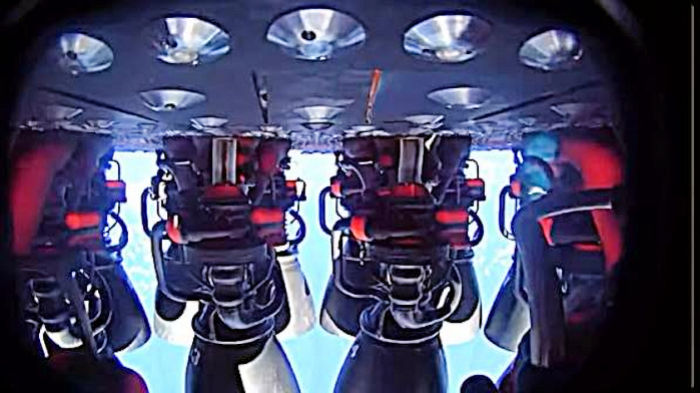
A final comment: There was a view during launch, starting about 2+04 after launch before staging of the engine array at the business end of Booster. You can see it in the image embedded above. The video was a stacked array of Raptor V3 engines, four wide in the engine bay. On each engine on the closest row, you could see the turbopump assemblies on either side of the engines glowing red. Imagine that, a rocket engine designed to burn cryogenic fuels, feeding gas from those cryogenics into turbopumps hard enough to make them glow red. Helluva job by the 30-something year old SpaceX engineers to design and build the machinery that works under those conditions.
5. Iran. The US completed about 12 nights of attacks on targets on CENTCOM’s updated target list. The new list was compiled and updated following the beginning of the ceasefire MOU last month. The last night of attacks was Friday night. The occasional Iranian attack on shipping through the Strait of Hormuz did manage to briefly jack up oil prices to the low $90/bbl range. I believe we are in LeMay land, where the solution is to kill as many Iranian regime dead enders so that there aren’t enough of them above room temperature left to dig weapons out of storage and pull triggers. Reports were that the attacks started mainly on coastal targets and moved inland. These were likely drone / missile storage sites, remaining C3I infrastructure, and most importantly IRGC leadership. This will likely take a while, though IRGC ability to continue hostilities is decreasing exponentially. Note that the Nazis planned a Werewolf insurgency after the war, it was ultimately unsuccessful. While there was sporadic sniper fire, weapons hoarding and targeted assassinations after surrender, most Germans were no longer interested in fighting. Allies arrested thousands of suspected members by 1946 effectively shutting down the putative insurgency. Iran is a different kettle of fish, as we have no boots on the ground, though there were reports last week of Kurdish action moving south out of Kurdistan. Note that the Iranian dead enders (IRGC, Twelvers, Clerics tied to the Mullahcracy) are not particularly beloved. They also managed to kill tens of thousands (or more) of their countrymen after the most recent round of protests against them. In response, Trump specifically told Iranian citizens to stay home until the dead enders are finished. OTOH, I expect that the survivors have been an excellent source of intel on remaining IRGC cells who are being systematically sent to their 72 Virginians. The remaining Iranian dead enders are absolutely convinced that all they have to do is to survive until the government here in the US changes. The next opportunity is the 2026 midterms. The one after that will be 2028. Kill enough of them and it just won’t matter what they do or what they believe.
6. FSD. Much has been written about Tesla’s Full Self Drive (FSDS), the ability of a new Tesla to leave the factory floor and deliver itself to the customer’s driveway without human intervention. FSD is coming to our world like a freight train. Unlike railroad traffic, adoption will not be a case of being either on the train or under it. Rather, it will be a case of being on it or being left behind, as FSD is rapidly becoming the safest way to drive. And yes, the laws will have to catch up with owners of FSD vehicles riding them in conditions making them physically unable to drive, which will in turn put MADD out of business. Tesla is not the only auto company working on FSD. Some are incrementally working their way to that capability. We recently purchased a Toyota Sienna. This one has a couple pieces of tech that work the FSD problem. One is lane assist, which will keep you within the while (or yellow) lines. It is disabled upon purchase but can be turned on. We haven’t tried it yet. The other is their upgraded cruise control, which is much more than cruise control seen on previous vehicles. This one is hooked into proximity sensors and will retain a programmed distance from the vehicle in front of you. As with most cruise controls, set the speed and let it go. Unlike most cruise controls, it will slow down and speed up in response to whatever is in the lane in front of you. Change the lane, and it reverts to whatever speed you have set. This is a remarkable improvement, a smart improvement. My Eldest tested its ability to maintain distance down to 14 mph, which is probably not recommended. Combine this smart cruise control with whatever they have going with their lane control, and Toyota has taken a couple large steps toward FSD.
7. Oysters. Florida engaged in a project to rebuild reefs in the Gulf of Mexico along the panhandle coast 2007 – 2024. The project dumped half a million pounds of recycled oyster and clam shells into the Gulf. The shells were gathered from seafood restaurants and seafood plants, essentially 250 tons of garbage over the period, 12 tons/year. While the volume is miniscule, roundly blasted by all the Usual Suspects as breathtakingly reckless and dangerous, the sea life disagreed. Turns out that the ocean life actually recycles the carcasses of dead animals, in this case, the shells of dead mollusks. Bacteria was up first, attaching themselves to the discarded shells, creating a biofilm, the starting point for all marine ecosystems. The shells released calcium into the water as they disintegrated, creating zones where some underwater organisms thrived. The shells also formed a foundation for juvenile mollusks to attach and grow. Before introducing the shells, only soft, sandy bottoms were found, and baby oysters and other similar mollusks did not have a solid place to anchor. The anchored mollusks grew and thrived, filtering the water and warding off algae blooms. The result was an increasingly thriving ecosystem for larger aquatic animals. The ocean is remarkably robust. Actually knowing how it operates helps us keep it healthy for much longer.
More later –
- AG