Howdy All, a few Interesting Items for your information. Enjoy –
In this issue –
1. Gasline
2. Checkmate
3. Dissent
4. Santa Barbara
5. Ryugu
6. Goddard
7. War on the Rocks
8. Fed
1. Gasline. Follow-up to last week’s discussion of the proposed natural gas pipeline in Alaska. Had an extended discussion with a long-time friend with no small amount of experience in the oil and natural gas world. He pointed out the error my ways and suggested an alternate approach to the project. As continuing education goes, this wasn’t nearly as painful as it was interesting. The proposed pipeline from Prudhoe to Kenai is sold as 800 miles long, though the route may be up to 1,100 miles long, with a cost somewhere north of $40 billion, though the entire project may end up being twice that. There is an alternative route possible, over the top, north of the Brooks Range, into Kotzebue. Depending on the route, this ends up being roughly half the distance. Half the pipe means half the capital cost that will need to be repaid over the lifetime of the project. Economics may dictate that the investors simply can’t (or won’t) pay for the long line. Permitting, as always will be an issue, as will construction of a liquefaction plant and shipping terminal, along with construction of a deep-water port at Kotz. As long as all this is done under Trump, permitting is not an issue. Coast Guard icebreaker support is also present, with a base at Nome, 200 miles south of Kotz. The discussion is reportedly underway, though not in public, which always bothers me. One other drawback will be an expectation that the long pipeline will provide cheap to nearly free natural gas for Fairbanks and the rest of the Railbelt. Response to this expectation is to ask the question: Is this a statewide project like Prudhoe Bay (and the Trans-Alaska Pipeline System to Valdez), or is this a Railbelt project? As it is a state project, the long-term interests of the State of Alaska along with the investments of the partners ought to take precedence. As a Railbelt project, the Railbelt bloody well ought to carry their own share of the total rather than scavenging on promises made. Should be an interesting discussion, whatever happens.
2. Checkmate. The Iran war may be winding down far quicker than anyone expected. Along with it, Trump appears to have checkmated both Iran’s remaining government, the IRGC and Basij military coup now in charge, and the EU via NATO. Quite the display of military and diplomatic virtuosity, that.
- Iran was checkmated with the destruction of military targets on Kharg Island, its single international shipping terminal last week. They had been quietly building military forces on the island with an expected US boots on the ground invasion. The attack left the oil infrastructure intact. The IRGC junta was smart enough not to do what Saddam did to Kuwait when they pulled out 25 years ago, and torch everything in sight. This gives Trump a stranglehold on all future Iranian oil shipments, one he will leverage like crazy for the foreseeable future.
- NATO checkmated itself, putting its very future existence in question with its initial refusal to send forces to ensure oil traffic through the Strait of Hormuz. Responses started with its “not our war” and got worse, that is until Trump called NATO out on its intransigence. This sets the stage for a possible (and maybe even likely) US withdrawal from NATO. As of week’s end, at least 20 nations are now in the process of promising and ultimately providing escort and minesweeping forces for shipping. Jeff Childers last Thursday covered the festivities nicely.
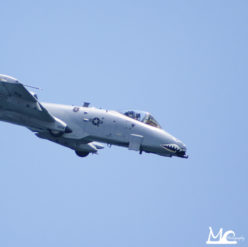
- Iran has been using small boats, its “Mosquito Fleet” to mine the Strait of Hormuz for the last week. The use of PT-sized small boats was wargamed nearly 40 years ago in a rather infamous naval war game in the late 1980s. In that game, the OPFOR (Iran) wins the war fairly decisively to the extent the game was halted, rules changed and reset to run again to completion. Suffice it to say, DoD did learn how to deal with the Mosquito boat problem. This time around, they started using A-10s on patrol and Apache attack helos to interdict the small boats in the water and on the Iranian coastline shore, making the A-10 community quite pleased with themselves.
- Final Iran story was a sad one, with the loss of a KC-135 and its crew of 6 over western Iraq. Parachutes were removed from tankers in the 1980s, so there is no ability to get out. Early descriptions of the accident told many of us this was a midair, as a second KC-135 recovered into Tel Aviv with damage to its tail. The rumor mill has this encounter being beak to beak (nose to nose), with a third KC-135 having to take evasive action to miss the fireball. We use refueling all the time these days, especially given the number of daily sorties being flown. The airspace gets very, very busy with lots of airframes in a small chunk of sky. Fart in the wrong direction, and you are toast. I expect the accident board inspection on this one to be particularly ugly. Prayers for those lost and their families.
3. Dissent. The anti-female trans jihad continues, with and en-banc panel of the Ninth Circus agreeing with the Washington State Human Rights Commission penalty against a pair of Korean women’s only spas for refusing to service a trans woman who did not have the surgical mutilation. This was the typical legal setup that had the trans guy showing up with all body parts intact and demanding full service. The women refused. And like we have seen with the decades long LGBTQWTF harassment of the Masterpiece Cake Shop in Colorado by its state government, the government put the hammer down on the Koreans with a discrimination finding and fine. The Ninth Circus trial court, and the next two appeals levels all agreed, with the most recent being the en-banc finding. Dissent was festive at best, by a Trump 2019 nominee who scorched his colleagues for their opinion in graphic language about swinging body parts, hiding what was really going on cloaked in judicial language. The other judges were shocked, simply shocked at being called out via the graphic language used. Fun reading, though NSFW. On to SCOTUS for the next round of trans harassment.
4. Santa Barbara. Oil started flowing through a pipeline from an offshore well, across Santa Barbara, to Kern County last week. The well and pipeline had been shut down for a decade due Cali’s endless war on oil. The opening was based on a Trump EO last year declaring a national emergency due to lack of oil production. The Houston-based company has been trying to restart flow for nearly a year. Note that there is a lot of oil production in Cali that has simply been shut down for a variety of excuses. This is the latest escalation between the Trump WH and Cali over energy policy. The production pipeline network was first closed in 2015 in response to a corroded pipe burst and oil spill resulting in the worst spill in history in that part of Cali. Rather than hammering the producers and fixing the problem, Cali opted to use the spill as an excuse to shut everything down. Trump invoked the Defense Production Act, ordering production to resume. Cali responded by calling out the environmental lawyers, demanding existing pipelines be immediately and completely removed. Should be a fun time.
5. Ryugu. Panspermia is the theory that life exists throughout the universe, distributed by space dust, meteors, asteroids, comets or spacecraft. It suggests that life on Earth (and elsewhere may have originated elsewhere, brought here by bodies that formed Earth or impacted it after formation. Astronomer Fred Hoyle was a relatively famous proponent of the theory. But if you have life elsewhere, logically. that life ought to be based on different chemistry, different molecules, breathing different liquids or gases. SciFi is thick with these sorts of speculative tales, which is what SciFi is supposed to do. What if life elsewhere is chemically similar? Why is that and what does it look like? The reason for these questions comes from sample analysis of chunks of 162173 Ryugu (1999 JU3) returned by the Japanese Hayabusa 2 probe Dec 2020. Ryugu is a spinning rubble pile, a carbonaceous chondrite, one of the oldest bodies ever sampled, dating around the formation of the Solar System. Analysis of Ryugu samples found all five nucleobases that construct RNA and DNA common to all life on this planet in the samples. This discovery tells us that these molecules can be created without the presence of life. Couple that with examples of moss, bacteria, viruses and microscopic animals (tardigrades) able to survive exposure to space for months to years, and we now suspect that life can be dispersed by meteor or asteroid impacts from bodies with things living on them and interact with chemicals created since the formation of the very solar system itself. Sobering, I think.
6. Goddard. Last week was the 100th anniversary of the first flight of a liquid fueled rocket built by Robert Goddard. Before Goddard, rockets were all solid fueled, improvements of what the Chinese invented in the 13th Century. For this massive step forward, Goddard is described as the “father of modern rocketry’, or of the space age itself. He provided much of the early science and engineering for rocketry, including proving that rocket propulsion would work in a vacuum. Before his work, the scientific view was that a rocket needed something to push against rather than relying on the momentum of what was going out of the back end. He pioneered guidance gyroscopes, multi-stage rockets, gimballed engines, and the use of turbopumps. As usual, at the time, he was mostly ignored if not ridiculed as a dreamer. His first liquid rocket burned gasoline and liquid oxygen for 20 seconds, got to 12.5 m, flew 56 m downrange and did not survive impact. The flight was not public knowledge for a decade afterwards.
7. War on the Rocks (WOTR). We have been treated to a real example of institutional capture of a formerly critical publication. This one was War on the Rocks, a previously popular media platform dedicated to strategy, defense and foreign affairs, essentially a critical defense publication trading on its connections. WOTR started out as a publication dedicated to cleaning up the mess that the foreign affairs. Intel, and military complex created for itself in the early 2010s. Its founder, Ryan Evans, is liberal and a fighter, who did a pretty good job early on. But that changed over the years as access outweighed criticism. A couple weeks ago, Evans doxed fellow blogger Cynical Publius, run by a retired Army Colonel with recent experience in the Sand Box, publishing his complete name thereby inviting the leftist mob to retaliate against one of the more effective right-wing accounts on X / Twitter. In response, steps uber researcher Data Republican to investigate what was behind the doxing. She is one of the most effective data analysts in the political information space and figured out why the doxing took place. She is a recommended follow on X / Twitter. She published that conclusion explaining why Evans was so upset. He was upset that Cynical Publius took a pot shot at military senior service colleges, detailing how they had abandoned their original professional military education mission for ideological conformity. Cynical Publius went on to call for institutional reform under Hegseth. He described how people now running War on the Rocks are embedded in the same DoD apparatus that administers the institutions Cynical Publius are now criticizing. In essence, War on the Rocks is no longer to be trusted as an independent voice for reform. Instead, it is a captured institution now promoting and defending another Dod and the War Colleges. Data Republican laid this all out. The change in orientation of War on the Rocks is striking. It was initially founded to challenge Washington foreign policy consensus in 2013. It only took seven years to figure out that access was more important than their reform message and built an institutional infrastructure that became the most prominent defense of the status quo existing today Institutional capture was complete by 2020. Publications that rely on access to the institutions they report on should not be relied upon to view then with a critical eye.
More later –
- AG